
AR/VR Experience Platform
Entertainment & Education Industry
300% increase in user engagement through immersive 3D experiences
Engagement Lift
Session Duration
Render Speed
Delivery Context And Business Outcome
Industry
Platform Type
Technology Stack
Duration
Engagement Model
Key Outcome
Client Industry, Timeline, Team, Stack, And Result
Client Industry
Entertainment & Education
Project Timeline
8 Months
Team Size
6 specialists
Tech Stack
WebXR, Unity 3D, Three.js
Headline Result
300% increase in user engagement
Problem Statement, Baseline, And Success Criteria
Clear pre-project constraints and measurable targets establish how outcomes are evaluated.
Problem Statement
Legacy VR platforms suffered high latency and poor frame rendering, degrading the user experience.
Goals And Success Criteria
Where Performance Started Before Delivery
Engagement Lift (Before)
Session Duration (Before)
Render Speed (Before)
What The Engagement Needed To Deliver
Infinoid Technologies Private Limited developed a cutting-edge AR/VR experience platform for entertainment, education, and retail with real-time 3D visualization, AR integration, and VR-enabled simulations.
Enter a world beyond reality — with Infinoid Technologies Private Limited's immersive AR/VR solutions.
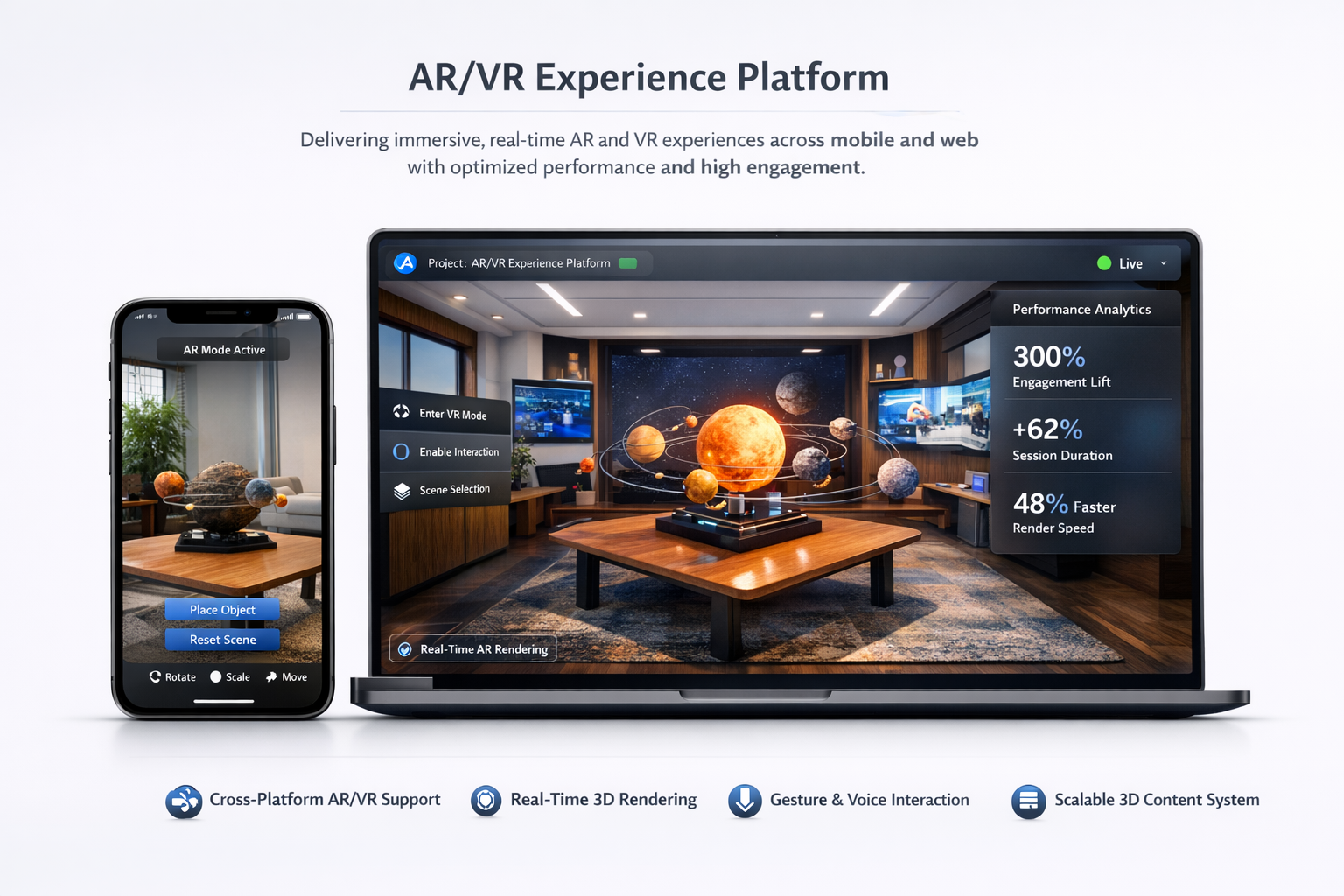
AR/VR experience platform overview
Discovery To Optimization With Duration
Discovery
1-2 weeksStakeholder interviews, baseline audit, and scope alignment.
Design
1-2 weeksUX flows, technical architecture, and sprint planning.
Build
4-8 weeksIncremental feature delivery, integrations, and instrumentation.
QA
1-2 weeksFunctional testing, performance validation, and accessibility checks.
Launch
3-5 daysControlled release, production validation, and monitoring.
Optimization
2-4 weeksPost-launch iteration based on telemetry and user feedback.
How The Product Direction Was Resolved
High Latency & Poor Frame Rendering
Legacy VR platforms suffered high latency and poor frame rendering, degrading the user experience.
Inadequate Mobile AR Support
Existing solutions did not effectively support mobile AR experiences.
Complex Cross-Device Deployment
Deploying content across web, VR headsets, and mobile devices created serious delivery complexity.
Lack Of Personalization
User experiences were generic because interaction data was not used to tailor sessions.
Built cross-platform AR/VR with WebXR and Unity 3D
Added gesture and voice recognition using TensorFlow.js
Created a web-based VR portal using Three.js
Personalized experiences using user session tracking
Integrated real-time multiplayer support using Socket.io
Deployed with CDN for fast access worldwide
Why This Approach Was Chosen
Built Cross-Platform AR/VR With WebXR And Unity 3D
Tradeoff: High Latency & Poor Frame Rendering
Rationale: Selected for long-term scalability, maintainability, and stronger business outcomes.
Added Gesture And Voice Recognition Using TensorFlow.js
Tradeoff: Inadequate Mobile AR Support
Rationale: Selected for long-term scalability, maintainability, and stronger business outcomes.
Created A Web-Based VR Portal Using Three.js
Tradeoff: Complex Cross-Device Deployment
Rationale: Selected for long-term scalability, maintainability, and stronger business outcomes.
Capabilities Delivered Across The Platform
AR Development
VR Development
3D Rendering
Interaction & Input
Deployment & Performance
Analytics & Personalization
Tools And Platforms Behind Delivery
Before And After Comparison With Hard Numbers
| Metric | Before | After | Delta |
|---|---|---|---|
| Engagement Lift | 100 index | 400 index | 300% |
| Session Duration | 100 index | 162 index | +62% |
| Render Speed | 100 index | 52 index | 48% faster |
Technical Outcomes After Launch
Lighthouse Performance
Core Web Vitals
Accessibility Score
Why This Delivery Approach Worked
Cross-Device Compatibility
Seamless experiences across web, mobile, and VR headsets from day one.
Low-Latency Performance
Advanced compression and optimized rendering kept visuals smooth and responsive.
Scalable 3D CMS
A robust content management system was designed to grow with immersive requirements.
Deep Personalization
ML-enhanced interaction logs supported more relevant experiences for each user.
Continuous Improvement Opportunities
Expand A/B testing coverage for high-traffic user journeys.
Add deeper event-level analytics for conversion funnels.
Extend automation around regression and accessibility audits.
Next step
Have A Similar Project?
Let’s build something exceptional together. Transform your vision into immersive reality.
What we cover
- 01
Named delivery from the Noida desk
- 02
Integrations against systems you already run
- 03
Hire dedicated engineers if you need people on your cadence
Typical first call · 30–45 min