
DevOps Transformation
Delivery systems
CI/CD, environments, and observability so releases stopped depending on one engineer’s laptop.
Release Cadence
Failed Deploys Caught
Mean Time To Detect
Delivery Context And Business Outcome
Industry
Duration
Technology Stack
Key Outcome
Client Industry, Timeline, Team, Stack, And Result
Client Industry
Product engineering
Project Timeline
8 weeks
Team Size
6 specialists
Tech Stack
CI, containers, logs, alerts
Headline Result
A release path the whole team can run
Problem Statement, Baseline, And Success Criteria
Clear pre-project constraints and measurable targets establish how outcomes are evaluated.
Problem Statement
Production changes were copied by hand with no record.
Goals And Success Criteria
Where Performance Started Before Delivery
Release Cadence (Before)
Failed Deploys Caught (Before)
Mean Time To Detect (Before)
What The Engagement Needed To Deliver
Infinoid replaced ad-hoc production copies with a pipeline, environment parity, and alerts tied to the services that actually fail.
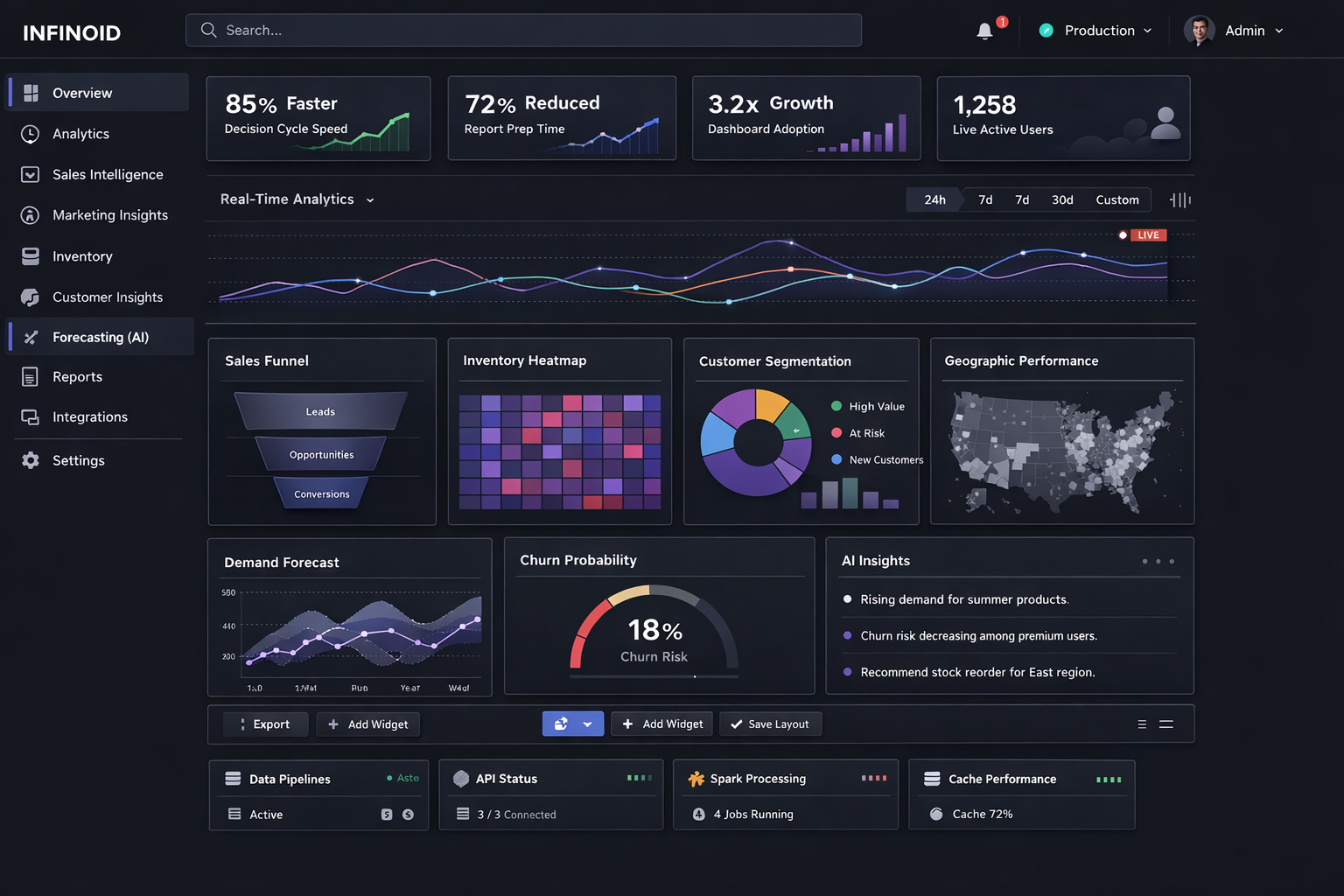
DevOps pipeline and monitoring
Discovery To Optimization With Duration
Discovery
1-2 weeksStakeholder interviews, baseline audit, and scope alignment.
Design
1-2 weeksUX flows, technical architecture, and sprint planning.
Build
4-8 weeksIncremental feature delivery, integrations, and instrumentation.
QA
1-2 weeksFunctional testing, performance validation, and accessibility checks.
Launch
3-5 daysControlled release, production validation, and monitoring.
Optimization
2-4 weeksPost-launch iteration based on telemetry and user feedback.
How The Product Direction Was Resolved
Laptop Deploys
Production changes were copied by hand with no record.
No Staging
Bugs appeared first for customers.
Silent Errors
Logs lived on a box nobody tailed.
Pipelines for test and deploy with a named owner per environment.
Staging that used the same artefacts as production.
Alerts on error rate and latency, not just “server ping”.
Why This Approach Was Chosen
Pipelines For Test And Deploy With A Named Owner Per Environment.
Tradeoff: Laptop deploys
Rationale: Selected for long-term scalability, maintainability, and stronger business outcomes.
Staging That Used The Same Artefacts As Production.
Tradeoff: No staging
Rationale: Selected for long-term scalability, maintainability, and stronger business outcomes.
Alerts On Error Rate And Latency, Not Just “server Ping”.
Tradeoff: Silent errors
Rationale: Selected for long-term scalability, maintainability, and stronger business outcomes.
Before And After Comparison With Hard Numbers
| Metric | Before | After | Delta |
|---|---|---|---|
| Release Cadence | 100 index | Weekly from monthly | Weekly from monthly |
| Failed Deploys Caught | 100 index | In pipeline | In pipeline |
| Mean Time To Detect | 100 index | 50 index | -50% |
Technical Outcomes After Launch
Lighthouse Performance
Core Web Vitals
Accessibility Score
Continuous Improvement Opportunities
Expand A/B testing coverage for high-traffic user journeys.
Add deeper event-level analytics for conversion funnels.
Extend automation around regression and accessibility audits.
Next step
Want Releases That Are Not A Ritual?
Tell us how you ship today. We will map CI/CD and observability as a first DevOps slice.
What we cover
- 01
Named delivery from the Noida desk
- 02
Integrations against systems you already run
- 03
Hire dedicated engineers if you need people on your cadence
Typical first call · 30–45 min